Showing posts with label Indian Mutiny. Show all posts

Thursday, 6 August 2026

The comeback kid.

Yes, it’s me the comeback kid, and I’ve err….comeback. I wanted to insert a sound file of a trumpet fanfare at this point but all I can afford at the moment is a gif of an old man tooting out land of hope and glory on a kazoo, or an old woman farting the opening bars of rule Britannia, so I don’t think I’ll bother.

Back earlier than expected I know, but some of the things I knew would stop all hobby activity medical wise have been put back until October (ish), pending further tests.

The building work chez moi is finished and only came in at double the budgeted amount. ((Sigh). My elderly neighbour Marie Therese had previously pointed out a patch of rough plaster in our adjacent cottage that she claimed had been a doorway between our two properties back in the day. 

That’d be an old doorway with a pre existing lintel and easily chopped through rubble infill, of course.

Shame that when it came to it, it wasn’t actually there…or anywhere else for that matter. “Mmmm” said Jean Phillipe, having chopped all the plaster off the wall in search of it. Did I want to carry on? The little voice in my head that sometimes tells me to kill postmen said, “Nah, If you could just stick all that rubble back up where it came from I think we’ll call it quits eh? Oh and here’s a tenner for your trouble.” Fortunately I ignored my inner voice like the doctors advise, but instead I started to laugh. I was still laughing when the wife led me away for a little lie down. 

Instead of the aforementioned easily chopped through rubble in a former doorway we were met by a 1m thick granite wall that took two men three days to cut through. If I was of meaner stock I’d go round Marie Therese’s house and bust her upside her head with my pimp stick, or some such. Still, the wife encouragingly said that if  I go back on the game I should be able to settle the bill for the work in ten years or so, so no harm no foul I guess.

As I whinged on about during my previous break in radio silence, it’s been too hot en general for painting so in the the few precious hours when I wasn’t lugging tons of rock down to the bottom of the old jardin (and crying into my tea) I did a bit of play testing with my Bundooks Indian mutiny rules. 

Given they were all my own work I actually had some fun with them but when I tidied them up and passed them over to a couple of mates to review they found every chink in my logic and every spelling error I’d become blind too. Doh. I’m not sure I can thank them enough for their general patience and indeed the constructive criticism that has made version 3167 soooooo much better, but I’ll have a go. Cheers chaps, I’ll buy you a pint of crème de menthe if my spot the ball entry ever comes up good.

As a final test my lad is coming over in September and if he finds no issues I might go as far as to put them on Wargames Vault, who knows? Objectively I’ve deffo bought worse in the past ((coughs - Victorian submarine warfare)) and obviously in my current fiscal circumstances I can’t turn down the chance of making my first million by Christmas, now can I? Besides, it’ll be easier than standing in fish net stockings all night doing favours for sailors. I mean, these rules are hex based, 28mm, platoon level, in an obscure period with expensive models. What’s not to like, apart from hexes, obscure periods, and expensive models? Watch out Lardies, watch out Warlord, I’m coming for ya!

Lol.  

Enough.

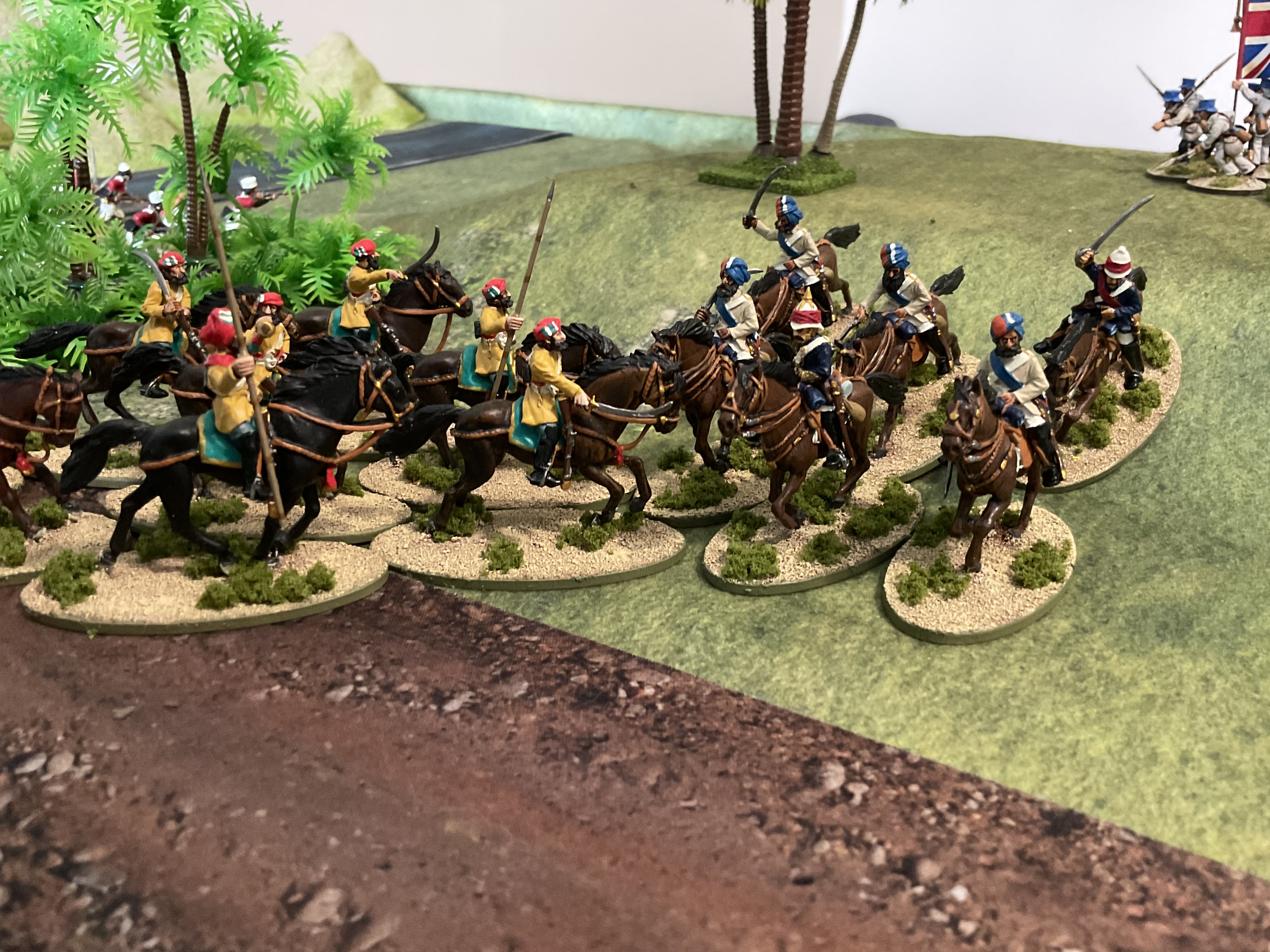
Here’s a game I played last week called “Rumble at Rangpur.”

They might be the famed Hodson’s horse, but meh, I’m an infantryman at heart so they’re just donkey wallopers to me. Nice opening piccie thought to act as blog style click bait.


I’d be the first to agree that an essential component of any good rule set is that players are forced to make decisions of import throughout the proceedings, however I’ve taken this a step or two further because I require my players to do the best with what they’ve got, and what they’ve got isn’t always what they need.  It isn’t everyone’s cup of tea I know, but how many commanders in real life have the right balance of units, perfectly positioned for a task they knew in advance that they’d be given?


First off there’s always an attacker and defender, which is a bit binary maybe, but it keeps things simple. The winner of a D6 roll gets to decide which they want to be. In this case the Indian player rolls highest and chooses to be the attacker, ensuring he gets more points to spend on his force construction than the British player.

Next, the attacker and the defender are both dealt (in secret) a playing card that determines their leadership characteristics. This is admittedly a bit contentious since it forces the player to adopt one of four different military mindsets, and the rules of engagement that your men have been trained to follow. Despite choosing to be the attacker our Indian commander has been dealt a heart which characterises him as either a bumbler a coward or a drunk. He won’t be able to activate all of his forces in a turn and both him and his command unit will run away (which may be a blessing) if effective fire is brought to bear on them. The little red tab marked “bumbler” is slid under his base to remind me of his status.

The British player goes through the same process, again in secret, and it turns out he is “savvy”. His guys are trained to use firepower over melee and he gets an extra chance at activating a unit every turn.

Still not knowing what he’s got to achieve the Indian attacking player now has to choose the forces he’s going to command in whatever fate throws at him. He has thirteen points and here’s what he chose.


The plucky Brit only has nine points as the defender so he chose these chaps:

Sadly I don’t have eight armed civilians (yet) so the bunch on the right have four armed manservant’s to pad out the numbers.

Terrain set up is done only by the defender (who doesn’t know what the attackers mission will be) and one of its prescriptive rules is that there must be a building, bridge, road junction or hill in the middle of the board as well as a cap on the number of hexes that can be covered by terrain overall. 

For this mission the British player chose to deploy a fortified customs house in the centre of the table and a metric ton of fish tank jungle. 

The last playing card drawn (three pictures up - 7 of diamonds) decides the mission that the Indian player, as the attacker, has to undertake. It turns out his mission is “breakthrough” and all he has to do is get one unit off the British players board edge. Simples. Naturally he’s not about to tell the British player what he needs to do.

The final bit of pre match buggering about is deployment. The defender deploys all of his forces anywhere on his own long board edge, while the attacker draws another playing card that limits him to certain portions of the board and even on some occasions allowing units to come in from the side. 


Plucky British defenders deployed along their board edge, with the cavalry on the more open flank. The civilians could have been deployed anywhere on the board, and in hind sight sight I should have put them in the building, but hey ho. Changing your mind afterwards because no one’s around to see you do it is still damned bad form in my book. 


Our Indian player found himself limited to the centre and right flank of his long board edge which meant he couldn’t squeeze everyone in on turn one. His cavalry were kept back and left to deploy when the British player had fully revealed his hand.


The Indian player is squeezed into the centre and right flank of his board edge with no room for his cavalry just yet.


Finally… after all the attackers units that could be deployed had been deployed the British defender is allowed to move one of his units to somewhere else on his board edge so long as their is space to accommodate them in contiguous hexes.

When described in detail this process sounds awfully long winded but I’ve managed the entire process in less than ten minutes every time, which I don’t think is too bad. 

Now then. Because you’ve all been very good and sat nice and still throughout, I’ll end this post here and run through a few aspects of the game itself next time. Soz if it was all a bit nerdy and boring…but face it we’re wargamers and boring and nerdy is what we do.

P.S. Peter Pig has always encouraged us to play the period not the rules so to settle disputes in a period correct manner I suggest punching each other in the face until a resolution is obtained (might being right) rather than any namby pamby dice rolling nonsense. I’m thinking of adding an in game combat bonus for anyone with mutton chops or a handsome moustache too, for what it’s worth.

lol

Laters potaters 

JBM


Friday, 1 May 2026

By Jove it’s Bundooks & Bayonets


I intimated last time that this post would be about the currently unloved ginger headed step child of my collection, ie my 100YW collection, but sadly, I lied.

Instead, and perhaps in compensation, I bring you some Indian Mutiny fodder. 

They say you can’t polish a turd…which is undoubtedly true, but you can of course always roll it in glitter - which is the approach I’ve just taken with a set of rules I wrote last year for the Indian Mutiny. They were almost erm…good. Almost. Tantalisingly close in fact…but while I grew disillusioned with them I failed to delete them off my computer in my usual fashion.

Which has been a blessing.

Because after months of dicking around with published (and very well regarded) rule sets, I’ve finally circled back to mine and might, just might, have something I’m happy enough to play actual games with. Are they perfect…nope…but they’re close enough for a paddy as my racist father would have said. 

To be clear the journeys been a long one on this particular front, and my experiments to date have included, 

1. The Men Who Would Be Kings. Great for general cinematic colonial adventures (which I love) but they really shine when fighting uncountable waves of savages who are happy to feed themselves into your Gardner guns arc of fire armed only with a kiwi fruit. 

2. The Sword and the Flame. Very old school (50yrs?) As difficult to get your hands on as a pair of elephants testicles, but once I had them I found I hated the close combat rules. Doh.

3. Sharpe Practise 2. An excellent set I cant honestly criticise. Sadly there’s too much detail in there for my drug befuddled brain to remember. It served as a constant reminder that I really am losing it and sort of took the fun out of proceedings. 

4. The Devils Wind. Sorry but I can’t get past that it sounds like the aftermath of a bad jalfrezi. 

5. Fist Full of Lead Bigger Battles. Almost. Almost. Probably came to these too late. I’ve now grown weary of roster sheets data cards and some of the more « amusing »  character traits ascribed to colonial officers. 

So then back to my own buggers muddle, my Frankenstein like mishmash of stolen ideas and ill thought through game mechanics. They’re probably crap…but they’re my crap…and if I really can’t recall the specifics of the terrain section on page 3 of 3 then I probably ought to accept that it’s over, call the nurse, and ask for the bedpan. I’m now on version 1.2 and the titles changed from “I don’t like it Sergeant - it’s too quiet”, through “Never mind the Bundooks” to “Bundooks and Bayonets”. They’re hex based, D6 ers, fire tables free and counters light (or lite as my American reader would have it) and they don’t contain nuts. 

Handsome fella ain’t he! Chat GPT knocked 15 years off my life and dressed me up as a colonial British East India Company officer which was jolly nice of it. Oh bless…look, actual hair on my head. I do miss you hair…Please come back.

My mutineers suffer from older weapons than their European opponents, fragile morale, and poor command and control, but they do not lack for pluck or intelligence and their greater numbers can often swing things in their favour.

Here’s a test game I ran with them last week.

The Indian forces surrounding Somerset House have set up several guns to bombard the defenders into submission. 

The 64th have exploited the breakthrough at the Mansanar bridge and the 1st platoon have advanced to within several hundred yards of the Somerset House perimeter. Their mission was to destroy the gun battery and seize or destroy two piles of supplies that the besieging force have looted from the EIC armory. Unfortunately their advance has not gone unnoticed and even as they close on their objectives a detachment of the 28th Native Infantry have been sent to block their path.

Three twelve man sections of the 28th Native Infantry advance to stop the company men in their tracks.

The card activation mechanic kicked the British in the teeth from the get go. A joker meant a random event and the 1D6 roll of 5 saw a conflict of interest arise within the Sikh troops on the right flank. They buggered off on turn 1.

Just as the normally doughty Sikhs were off to the shops the left wing of the Indian force benefitted from a double activation and made it to the camp full of arms and ammo. All they had to do now was hold against erm…well…erm, zero opposition.

In the centre of the field and advancing on the dug in cannon, men from the 64th press forward, backed by the forces command group. Each section has an nco that does all of the real leading. The command group act as a potential rallying point for figures that rout and ensure that the kettle is on at all times. 


The British capture their left flank objective while the Indians charge bravely at them. The Brits operate in 8 man sections and the natives 12 man sections. Two native sepoys were shot at close range (there is no wounding in my rules only “out off the fight”). If you think that might be an abstraction too far, I challenge you to pick yourself up and carry on fighting when a 30gram lump of lead has just hit you at 1000 ft per second. Yeah, thought not. The two guys with the yellow counters had near misses and are “shocked”. In the end of turn morale check they ran for it and the still intact group of four in the neighbouring hex followed in their wake since routing has a negative effect on those in neighbouring hexes. The British lads behind the crates will need to spend a turn reloading those muskets if they wish to fire again.


Having tested the musketry rules I moved over to the centre of the field for a shufti at the morale section. The Indians here have charged into a hex containing four British soldiers and due to some excellent  die rolling “slotted” all four of them. The other four British soldiers have turned to face them and would have no doubt avenged their comrades had not my builder turned up to give me a quote. 

Everything worked out very satisfactorily, so if things continue to go well with the testing I’ll jump back into my Mutiny campaign and finish it off (it’s only been a year since the last update) lol. 

In other news, no sign of my blue moon ECW lads (old glory UK seem, erm, a bit “laid back” shall we say about sending stuff out. When I contacted them last week by email I got a “oh yeah, I was going to get in touch and let you know I didn’t have one of the packs you ordered - any thoughts on what you’d like instead?” Despite my prompt return email, they’ve still not turned up. Sheesh…you’d think I lived in ruddy Kathmandu.

Catch you on the flip side.


Thursday, 29 May 2025

The dust up at Mansanar bridge

In this scenario the British need to capture the bridge across the Mansanar canal since the road across it gives the most direct approach to the besieged defenders of Salisbury house. 


In real life the mutineers beat the Crown forces on a number of occasions but were always hampered by poor command and brittle morale. In this battle I’ve attempted to reflect that - the mutineers have a bigger force, but, if the British actually get on to the bridge they will consider the engagement lost and immediately melt away.


They have deployed in a fairly random fashion around the canal bridge, intent only on creating a blockade of the garrison at Cawnpore. Morrisons mobile column trying to actually break out from the town comes as an unexpected surprise. 


All figures are Empress Miniatures 28mm and the rules used were The Men Who Would Be Kings. The British have 9 turns to capture the bridge before retiring to look for an alternative crossing point.


T1. Frobisher’s platoon enter on the lower edge of the board, moving at the double despite the heat. Ahead of them Mountjoy’s cavalry troop ride along the flank to flush out any hidden mutineers.

T2. Mountjoy’s troop find nothing to disturb the infantry as the canter past several potential ambush sites but just as they prepare to swing in towards the bridge itself…blammo… In the last position on this side of the board the dice revealed a platoon of the 28th Native Infantry who’d heard the cavalry coming. Mountjoy (whose die generated trait was short sighted) had succeeded in finding the enemy, though sadly with the loss of several of his troopers. The fire was from long range, so Mountjoy could not order a charge or return fire (he couldn’t see who was shooting) and instead ordered his men back the way they’d come.

T2. The men of the 28th let fly in a slightly uncoordinated fashion with their obsolete muskets, and cheer as several cavalrymen fall. 

T2. Secure in the knowledge that no enemy is present on their right flank the men of Urquhart’s platoon advance on the bridge along the central road - led somewhat superfluously by Colonel Morrison on his mighty steed - Maximus. 

T3. With their running shoes on (Urquhart is a fitness fanatic) the platoon managed to keep up with the colonel on his horse until they crossed the hump in the road and discovered mutineers on the ridge to their left.

T3. Oh bugger! A die roll revealed both potential ambush sites on the leftmost ridge contained mutineers. In the Indian turn the cannon and the shako wearing elite of the 28th fired into the British on the road. 

T3. The cannon fired and scored several hits. The chances of the leader going down are slim (a double 1 is required) so I rolled for it…and got… a double 1. Was this the end for colonel Morrison? Nope. The trait he’d rolled before game start was bulletproof bumbler so he could ignore the first hit. Perhaps the round shot took off his hat? Despite the musket fire from the soldiers on the hill he waved his sword and twirled his moustache to inspire the soldiers now pinned on the road. 

T4. Yet more of Urquhart’s men fell to musket fire and they became pinned again but the colonels moustache twirling was impressive enough to prevent them from running. Fearing for his short sighted leaders reputation Daffadar (sergeant) Kuldip Singh grabbed Mountjoy’s horses reigns and swerved the troop over the brow of the ridge towards the hurriedly reloading cannon. During the Indian portion of this turn another unit (of irregular horse) is activated on the bridge itself. All potential starting points have now been diced for so any unrevealed Indian units from their force pool can only enter the game from the far side of the canal.

T5. The Indian horseman charge off the bridge into the unsuspecting flank of Mountjoy’s troop. Brave Daffadar Singh and several others go down under the slashing tulwars but the fight doesn’t go the mutineers way and they are forced to retire. The rules allow for cavalry follow ups in this event so trying to catch up with some blurry figures he assumed to be his own men Mountjoy thunders close behind, his remaining troopers in tow. A second contact and skirmish causes the Indians to flee still further. 

T5. Still trying to catch those he assumes to be his own men Mountjoy makes it onto the bridge. The mutineers let out a collective moan of despair at the sahibs disregard for life and limb. Assuming he is protected somehow by the white queens magic they throw away their weapons and scatter. 

Game over and won within 5 turns! 


For a solo battle this turned out to be quite entertaining. I was convinced that the British would lose given the force disparity and the early casualties which pinned the assault force in place. The flukiness (is that word?) of the actual win and the fact that colonel Morrison should have been killed (except for his crappy character trait) made it a good, if fairly short, run out. 


So then the road is now open and Morrison’s mobile column is primed for a rapid march to Salisbury house. 


I think that calls for a quick huzzah don’t you? And perhaps a gong for Lt Mountjoy?


Huzzah!


Toodleooh. 


Monday, 19 May 2025

Morrison marches forth

Readers will recall that the redoubtable Mr Morrison sent me 36 beautifully painted Empress Miniatures (1st Madras Fusileers) last year, which acted as a massive boost to my nascent Indian mutiny project. The lads were accompanied by a mounted officer whom I’ve named Colonel Morrison in his honour. The following game will be his first run out using The Men Who Would Be Kings rules. 

The story so far. 

Indian mutineers had risen up in the fictional town of Jullundpur, forcing a small garrison of the 64th and the Weatherby-Blythe family to seek refuge in the Salisbury House EIC compound. Captain Lawrence of the 64th, disguised as a woman, managed to slip through the mutineer lines in the back of a cart and raise the alarm at Cawnpore.

Despite the rebellions occurring all around them, General Wheeler (officer in command) felt his position was quite secure and he ordered Colonel Morrison to form a movable column in order to relieve the Salisbury House defenders and return with them to the greater safety of the Cawnpore garrison.

The movable column is an adhoc force comprised of the 1st Madras Fusileers escorted by several troops of irregular cavalry. Morrison’s intention is to secure the bridge over the Royal military canal at Mansanar and reach Jullundpur in a rapid 3 day march. Other crossing points of the canal are available but securing any of those instead will lead to unacceptable delays and stiffening resistance. 

The scenario

The action is centred around the seizure of the bridge across the canal at Mansanar and the following 16 point British force is pitched against a defending 24 point Indian mutineer force. For easy of play all Indian units are led by officers with no traits and have a standardised leadership value of 8+ while the British units had the diced for characteristics as follows. 

OC - Colonel Morrison: “Bullet proof bumbler” (sorry Aly) Leadership value 9+. Luckily for him, if not his men, this Jonah leads a charmed life. Re roll (once) every successful leader casualty he falls foul of. 

Colonel Morrison - will add +1 discipline to any unit he is attached to. 

1st Platoon, C Company, 1st Madras Fusileers: Captain Frobisher - Fine swordsman. Roll 2 extra dice in melee. Leadership 5+ (very good).

Captain Frobisher - flashing blade extraordinaire.

2nd Platoon, C Company, 1st Madras Fusileers: Lieutenant Urquhart - Jolly sporty. This unit may add +2 inches to any at the double actions. Leadership 7+

Lieutenant Urquhart - All those hours spent at “rugger” are about to bare fruit.

2nd Troop - Prendergast’s Irregular Horse: Lieutenant Mountjoy - Short sighted. Cannot give order to charge or fire beyond short range. Leadership 7+

Lieutenant Mountjoy - What enemy? Where? Are you taking the pith (helmet). 

The British may enter anywhere along the leftmost board edge, though I’m minded at the moment to try a run along the bottom of the picture. No point engaging everything on the table, what! 


Special scenario rules

There are 12 possible locations for enemy units to be encountered, each will be diced for / revealed when line of sight is established. Any units absent from these positions will automatically appear beyond the bridge at location 12 which will always be the last location to be revealed. 

The British need to have a unit on the bridge before the conclusion of turn 9 to secure a win. 

All retreating Indian units must fall back towards or across the bridge. 

All stands of jungle terrain are impenetrable and block line of sight.

It is hellish hot (and not a dry heat either, lol) so all British infantry lose 1 inch movement / activation.

Any Indian defenders will immediately disengage and retire if a British unit makes it onto the bridge. 

Okay, I’ll be giving this a bash in the next day or so, so I’ll try and produce the batrep before month end - with any luck.

Toodleooh. 

P.s. if anyone knows where I can get my mitts on river terrain at least 15cm wide I’d be grateful of the heads up. I made some myself but it really didn’t cut the mustard. 


Sunday, 6 April 2025

The siege of Salisbury House

I played a game the other day that went undocumented on the blog but the upshot of it was that the British retreated to the safety of the Salisbury House compound and sent out a message asking for help from the Lucknow garrison (Captain Lawrence disguised as a native and hidden in the back of a cart). 

The next game involved an attempt by the mutineers to storm the compound and was played over a week ago. Although I’ve lost my notes the following pictures will hopefully give a flavour of the action. The rules used were The Men Who Would Be Kings and all the miniatures are Empress 28mm. Both sides started the game with 25 point forces and the winner would be who controlled Salisbury house itself after 9 turns.

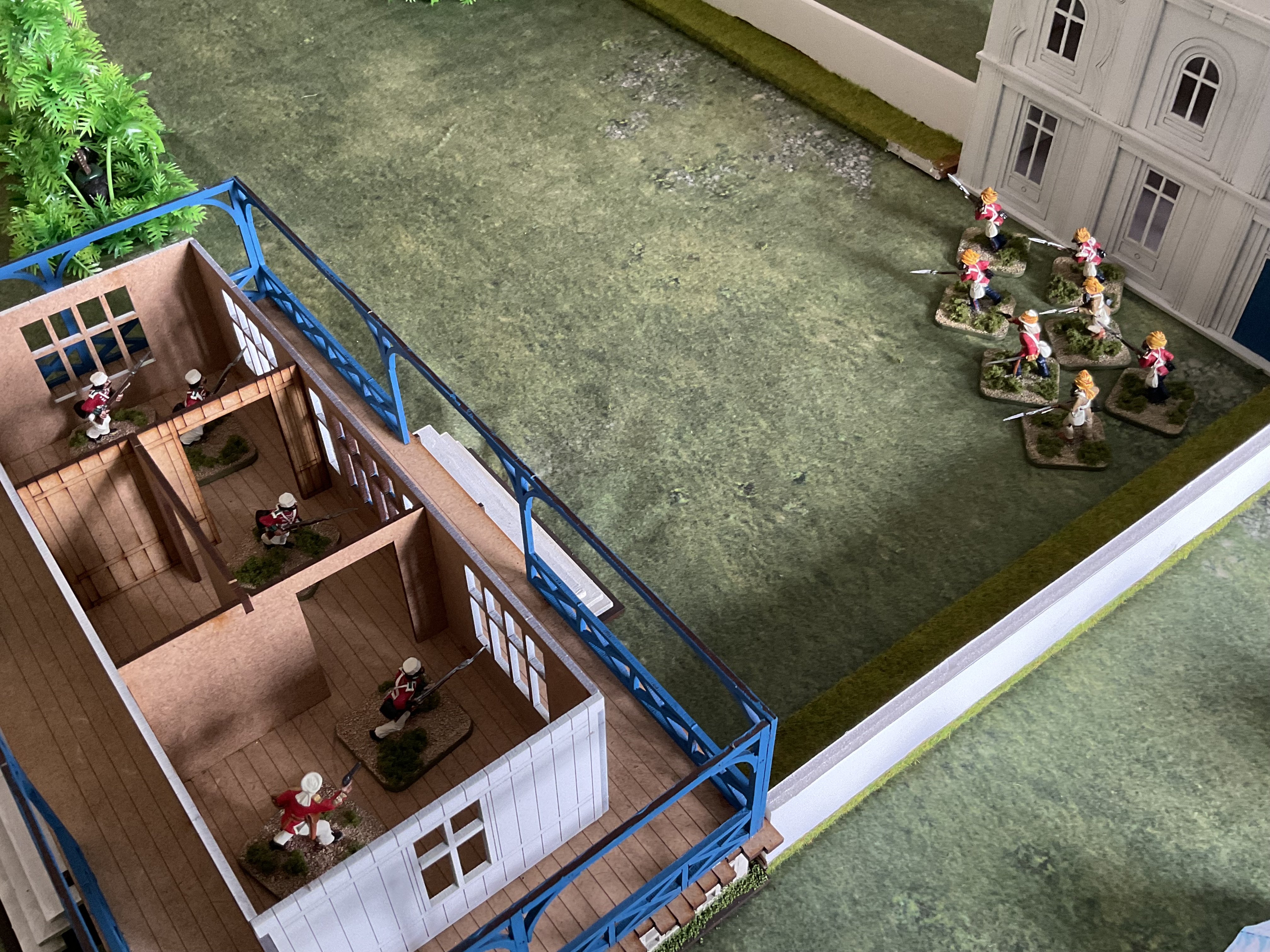
First up - a view of a part of the compound which is assumed to extend off board in several direction but is bounded in its entirety by a 12ft high rendered mud brick wall. Seen here are the main entrance (centre) and the tradesman’s entrance (snigger snigger) on the right.  The modular perimeter wall was badly and hurriedly scratch built but serves okay for now. In the background is another bungalow, to the left a tented field hospital and in just behind the wall in the foreground a walled croquet pitch.


I think this shot was taken around turn 2. The sneaky sepoys used a cannon to blow a hole in the perimeter wall - only to discover a British cannon looking back at them. Several waves of sepoys attacked the main entrance, the tradesman’s entrance and the left most portion of the wall itself. 


The defenders of this portion of the compound were two platoons of the 64th Regiment, a 9lb artillery piece and a platoon of Sikh Police. The Sikhs covered the rear of Salisbury house while the gun and the two platoons of the 64th covered the front. Despite complaints from the ladies the 64th took up a defensive position within the walled croquet area and made a right mess of the lawn as a result. 


Backs to the wall… Thankfully the battle was paused at this point for several hours while the servants came out and removed all the unsightly rubble from the smashed wall. Good job everyone.


The sepoys attacked from four directions, through the hole in the wall, below…


A mob entered via the tradesman’s entrance (sorry I still want to snigger) and tried to get onto the croquet lawn.


Began climbing over the wall itself…


And even snuck into the compound from the off board right flank. Definitely not cricket.


After some horrendous sepoy losses, they managed to secure the bungalow and control of the croquet pitch. 


The forces of colonial oppression still occupy Salisbury house, so they won, but the 12 wounded European soldiers that were the cost of holding off the horde are now being treated in tents that are constantly under desultory fire from the bungalow. 

Meanwhile, 40 miles to the west a small relief column under a colonel Morrison has been despatched from Lucknow. We can only hope he arrives in time! There’ll be no bullying off for the final chukka until the mutineers can be cleared from the croquet pitch, that’s for sure.

And finally. 

I’ve had a blissful three weeks or thereabouts without exposure to any news or current events. I strongly recommend it. Apparently the world still turns without me worrying about it. Who knew? No mushroom clouds on the horizon so all must be okay.

Music is and always has been a great soother of the noggin. Painting the Empress miniatures was largely accomplished while listening to an Indian themed sound track. Here’s an example which you won’t like and will skip out of after the few bars but which greater minds than mine have described as the best Beatles track they neither wrote or performed.


A bit of Tatva…


And this which is just a great laugh as well as a great song…


Look after yourselves mes amis.


Thursday, 27 March 2025

Mrs Fanshaw’s hat - game report + exciting crisp news

Well it was quick and very bloody and a little anti climactic. 12 turns in 30 minutes which would have been 20 if I hadn’t had to keep reminding myself of how the rules work. [long time reading - first time playing]. Somehow the gloss has gone off solo play these days.

Captain Napier plus six soldiers and the two Weatherby-Blythe girls entered the table on a mission to recover Mrs Fanshaw’s best hat before the beastly mutineers could get their grubby paws on it.

Mrs F’s bungalow had been randomly surrounded by groups of militant soldiery (represented initially by playing cards) and the playing area divided into 6 outer zones and 1 central zone containing the bungalow and the hat. 

Night had fallen. A dice roll determined that Napiers force came on in zone 3 and their arrival caused the playing card for the zone to be immediately revealed. If the card had been a black suit then Napier would have been unopposed but it wasn’t it was red with a value of 5 - meaning 5 sepoys had been surprised by the groups arrival. 

Not exactly fair odds as it turned out. They probably should have tried the “hug it out” strategy.


Despite Napier having a number of initiative advantages over the leaderless sepoys they unexpectedly got to go first - shouting angrily as they moved towards the imperial interlopers. Note - All firearms start the game unloaded, the Sepoys weapons by omission and the imperial troops by design. Any gunshot would alert the entire mutineer force to the interlopers presence and cause them to move towards  the sounds location.

The mutineers moved into contact with Napiers men and sprang straight into melee. Despite being outnumbered they put up a stiff fight. On the right of the imperial line Havildar (Sergeant) Kuldip Singh barely managed to parry his assailants bayonet while in the centre the extra imperial numbers and the poor training of the sepoys caused the mutineers assault to only cause the death of one defender. The only other person to come a cropper was Captain Napier who went down with a bayonet in the belly.

The imperial response was swift and deadly. Havildar Singh knocked his assailant to the ground with his rifle butt and finished him off on the floor while the other troops in the centre quickly overwhelmed the remaining mutineers. 

Dukin’ it out mano a mano. 


Kuldip, now in command, ordered his force to close up and consolidate near the corner of the bungalow. Once everyone was in place they rushed over the balcony railing to find…

A black card indicating no one was in the building!

The hat was quickly located and since they could now return across an uncontested route it was pretty much game over. As it turned out they had a very lucky set up since post game I turned over all the cards to reveal that there were 21 other enemy soldiers in the zones adjacent to them. Captain Napier was pretty far gone when his men found him but they managed to drag him back to the district office compound where he became the first occupant of the defenders impromptu field hospital. 

Salisbury House - district office for the Honorable East India Company at Jullundpur. The tented area on the left is the impromptu field hospital. Occupants 1, staff 0, medical supplies erm… 1 x packet of Bile Beans and a jar of camphorated oil.


Mrs Fanshaw was presented with her hat and she tried to hide her displeasure at the way it had been crumpled as she boarded the last passenger carrying boat upstream to Lucknow.

Results wise the imperial side scored 20VP for getting the hat back off the board and a further 10VP for killing 5 mutineers. For their part the mutineers scored 10VP for “killing” Captain Napier and 2 points for the poor Sikh fella they chopped up. 

I call it a resounding win for the forces of the white queen though I suspect Captain Napier’s family might view things differently.

And so dear reader there are two life lessons for you in this little game, firstly “never volunteer for anything” and secondly, “no good deed goes unpunished”. 

Take heed.

So the game was a bit disappointing over all but fortunately the real excitement of the day came about from a late visit to Carrefour. 

My letter last year to President Macron bemoaning the sorry state of France’s crisps brought about the immediate release of curry flavour. Now they have gone one step further and doubled down with…


Clearly, when the honour of France is at stake anything is possible.

Walkers…you’d better pull your finger out.

Next battle report will be the siege of Salisbury House. 


Toodleooh.